By Frances
Based on Wine Enthusiast article by Aleks Zecevic April 2023
What used to be GDR, German Democratic Republic, now East Germany, was and is well known for its beer culture, not so much for its wine, or so I thought. I rationalized that it was probably due to their cool climate, which is not the best for grape ripening, since Germany sits very close to the 51th parallel. As it happens, over simplifying is always an easy and lazy way out. I should’ve known better because there is much more to the wine history of that region than I thought.
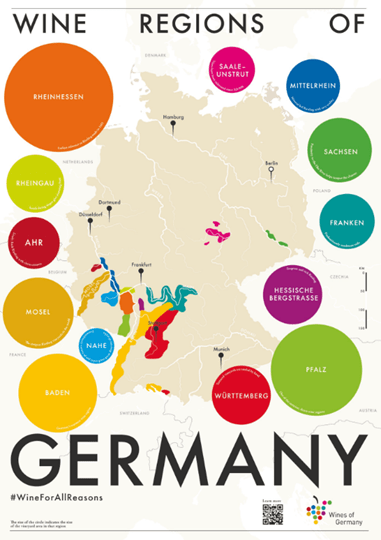
Since 1990, reunited Germany has increased its wine consumption to an all time high of 5.4 gallons per person in 2010* That caught my attention. Quality is a factor for that growth. Homegrown wine is again on the map due to its clean fruit flavor. This was not the case before 1989. East Germany has two of the Country’s thirteen recognized regions, SAALE-UNSTRUT which is the most northerly region, cultivating 75% white grapes and has been cultivating vines since 998 AC and SACHSEN, the most easterly region, 85% white wine, close to the Elbe river which helps maintain a reliable cool climate.
Before 1989, in SAALE-UNSTRUT there were only three wineries and they were government-owned cooperatives.* “People weren’t allowed to produce wine privately” says Sandro Sperk, winemaker from Bohme & Tochter. As a consequence, wine in Eastern Europe became a commodity, mass produced with little quality. Growers sold to coops and in return were paid with wine bottles. So wine bottles became a secondary currency. “Some made wine secretly, selling it illegally or using it to pay for other goods”-Sandro Sperk. These three wine coops has overcome phylloxera, Nazis, WWII but could not survive communism, which almost erased wine culture. The Berlin wall fell on November 9, 1989. Slowly privately owned vineyards started to rebuild the estates. The grapes that are best suited for these regions are the ones best for cool climate and that ripen fast. A classic in Muller-Thurgau, which was created by professor Herman Muller in 1882, a cross between Riesling and Gutedel or Chasselas in France. Riesling is the most popular also Pinot Noir and Silvaner. When in Germany try Rieslings from Mosel, Pfalz and Rheinhessen, from Weingut Reverchon but do not foget to try wine from Saale-Unstrut region like Bohme & Tochter. ENJOY!
*Wine Enthusiast, Alek Zecevic, April 2023
*Wiley Exploring Wine Chapter 11.
 New2Wine